Career Profiles
Saving Lives Behind the Scenes: The Role of a Public Health Lab Scientist
Read how Raymond Okolo's deeply personal experience led him to a career in health care.
Career Profiles
Read how Raymond Okolo's deeply personal experience led him to a career in health care.
Raymond Okolo
Laboratory Scientist, Newborn Screening Unit
Missouri State Public Health Laboratory
My journey into health care began with a deeply personal experience — the loss of my mother due to poor health care conditions in Nigeria. That moment changed everything for me. It opened my eyes to the critical gaps in access, quality and infrastructure that exist in many health systems.
Losing her gave me a strong sense of purpose. I knew I wanted to be part of the solution to work toward a future where families wouldn’t have to suffer the same loss mine did. That’s what led me to pursue a career in health care, and ultimately, to become a laboratory scientist.
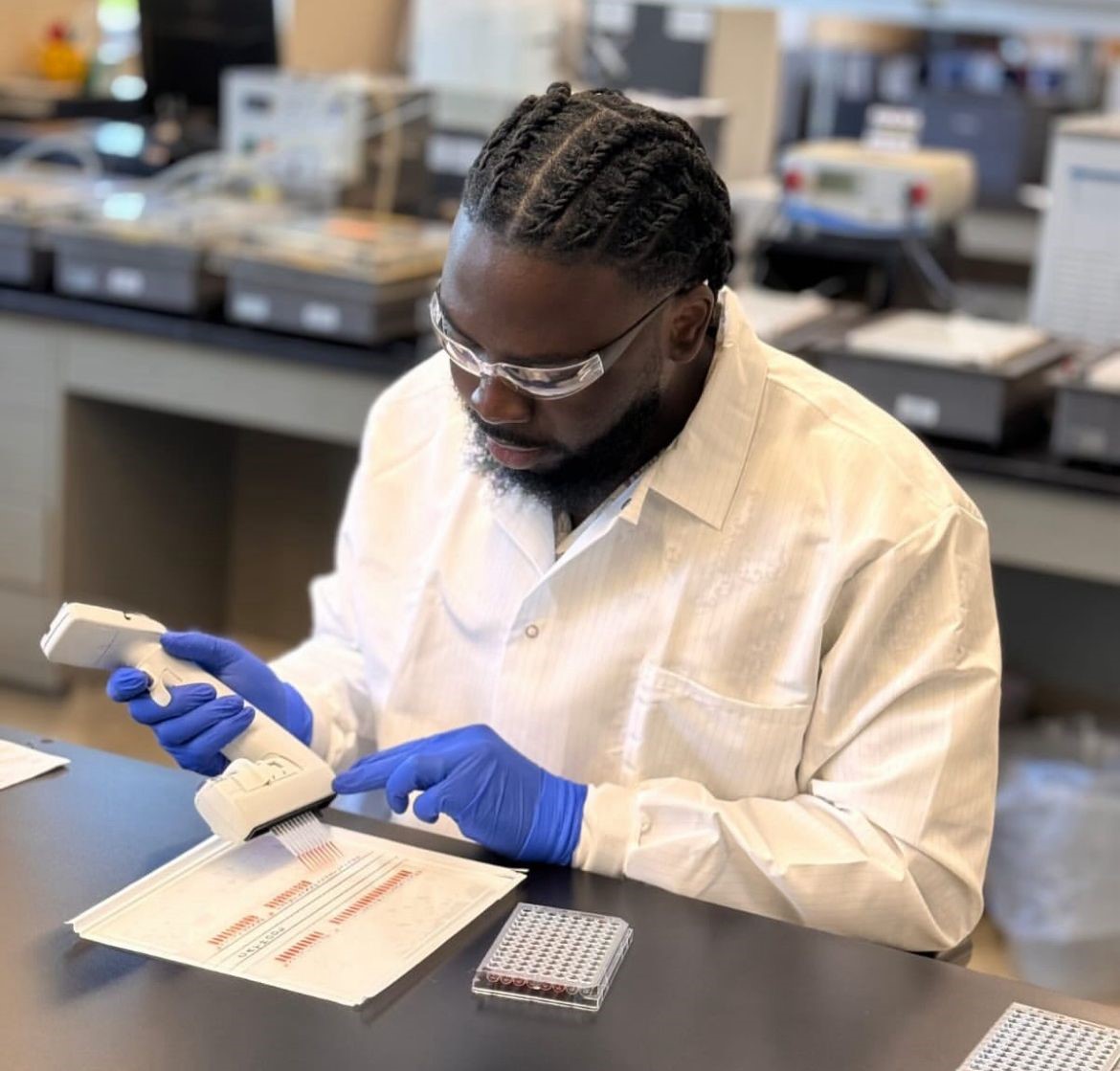
Today, I work as a laboratory scientist in the Newborn Screening Unit at the Missouri State Public Health Laboratory. Every day, I analyze blood samples from newborns across the state to detect rare but serious conditions that might not show symptoms right away but could have lifelong consequences if left untreated.
My work involves careful preparation, quality control and coordination with health care providers to ensure timely and accurate results. It’s a role that demands precision, consistency and collaboration with various departments.
What I love most about this work is knowing that I’m making a real impact. Early detection through newborn screening can change a child’s life forever. It’s incredibly rewarding to be part of something so meaningful, even if I’m not interacting with patients directly.
I also enjoy the scientific side of the job. There’s always something new to learn, a process to improve or technology to master. That constant challenge keeps me engaged.
One of the biggest challenges I’ve faced in my career has been imposter syndrome. As a young professional and a minority in the health care field, I’ve had moments where I questioned whether I truly belonged, or if I was making the kind of impact I hoped to.
What helped me through that was mentorship, supportive colleagues and reminding myself of why I chose this path. I also committed to continuously learning and building my skills, which gradually helped me gain confidence. With time, I’ve learned to trust my training, lean into my strengths, and speak up, especially when advocating for patients and underrepresented communities.
If you’re thinking about a career in health care, you’ll need dedication, empathy and a lot of resilience.
Stay curious. Ask questions. Find mentors. And never lose sight of the reason you chose this path. The field is diverse, so be open to discovering different areas within health care where your strengths can shine.
Don’t forget to care for yourself, too. Compassion fatigue is real, and you can’t pour from an empty cup.
A lot of people assume that lab scientists are disconnected from patient care. While we are behind the scenes, the truth is the work we do is foundational. The tests we run and the data we generate often shape diagnoses, treatments and outcomes.
We may not wear white coats in hospital rooms, but we’re just as committed to saving lives.
The future of laboratory science is exciting. With advancements in genomics, automation, and data integration, we’re able to screen faster, more precisely, and with greater reach. I believe we’ll continue to see growth in personalized medicine and a stronger focus on health equity, making sure all communities have access to high-quality, timely testing.
As our field evolves, I’m proud to be part of a profession that sits at the intersection of science, technology and human care. Behind the microscope, we’re helping to build a healthier world.